
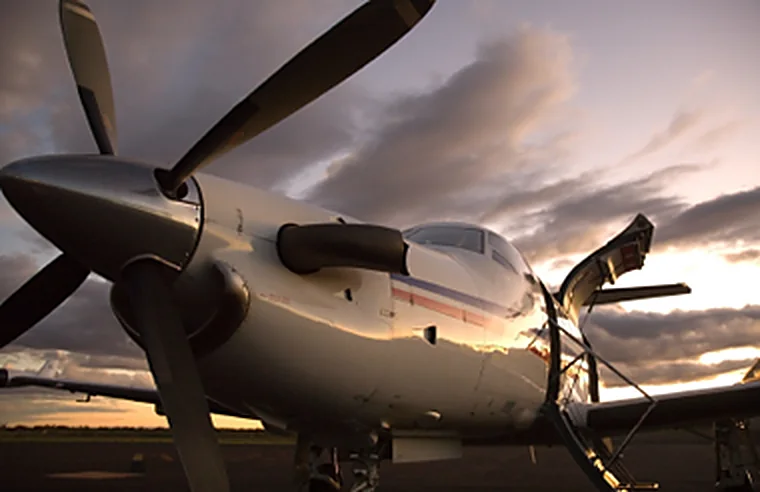
Thirty seconds to one minute. That is the time of useful consciousness the FAA lists for 30,000 feet after a rapid decompression, in Figure 2-3 of AC 61-107B Chg 1. And 30,000 feet is the maximum operating altitude on EASA's data sheet for every PC-12 model, so that airplane is a good place to start on whether you need a high altitude endorsement.
Do you need a high altitude endorsement?
You do if you act as pilot in command of an airplane that meets the test in 14 CFR 61.31(g) and no exception applies. The rule's words: "a pressurized aircraft (an aircraft that has a service ceiling or maximum operating altitude, whichever is lower, above 25,000 feet MSL)."
So take two numbers from your AFM, use the lower one, and ask whether it is above 25,000 feet MSL. A pressurized airplane can sit outside this rule if the lower of its two altitude numbers is 25,000 feet or less.
Two parts come with it: ground training under (g)(1) and flight training under (g)(2), recorded by endorsement. Paragraph (g)(3) lists exceptions, including pilot in command time before April 15, 1991, and certain military or Part 121, 125 or 135 proficiency checks. Check that paragraph against your own records.
Does the PC-12 need a high altitude endorsement?
Yes on its published limit, unless a (g)(3) exception fits you. EASA.A.089 Issue 11, dated July 7, 2025, lists 30,000 feet for the PC-12, PC-12/45, PC-12/47, PC-12/47E and PC-12/47G (pp.7, 13, 19, 29, 36). The FAA's data sheet for the airplane, A78EU, has no altitude line in its text, so confirm the operating limit and the service ceiling in your AFM.
A PC-12 pilot can need this endorsement and no type rating at the same time. A78EU tops out at 10,450 lb, under the line explained in does a King Air require a type rating.
Published tuition. Travel expenses added if we come to you. Tuition shown takes effect January 1, 2027. Courses before then are at the current rate, so ask us.
Which aircraft are above 25,000 feet, model by model?
These are the limits printed on type certificate data sheets, read on November 2, 2026. They cover one of the rule's two numbers: a data sheet gives the operating limit, not the service ceiling.
| Aircraft | Limit on the data sheet | Above 25,000 ft? | Data sheet, page |
|---|---|---|---|
| P210N, S/N P21000001 through P21000150 | 23,000 ft placard | No | 3A21 p.40 |
| P210R | 25,000 ft | No, not above | 3A21 p.23 |
| Malibu, Mirage, Matrix | 25,000 ft | No, not above | A25SO pp.2, 3, 7 |
| Mojave (PA-31P-350) | 25,000 ft | No, not above | A8EA p.14 |
| Aerostar 601P, 602P, 700P | 25,000 ft, or 30,000 ft with AAC Options 262 and 264 | Depends on options | A17WE |
| Pressurized Navajo (PA-31P), Cheyenne I, II | 29,000 ft | Yes | A8EA |
| Meridian, M600, M700 | 30,000 ft | Yes | A25SO pp.5, 8, 10 |
| PC-12, all models on the sheet | 30,000 ft | Yes | EASA.A.089 |
| Duke | 30,000 ft | Yes | A12CE p.3 |
| King Air 65-90, A90, B90, C90, C90A, C90GT, C90GTi | 30,000 ft | Yes | 3A20 |
| Conquest I (425) | 30,000 ft | Yes | A7CE p.20 |
| TBM | 30,000 or 31,000 ft by modification | Yes | A60EU p.5 |
| King Air F90, 100, A100, B100 | 31,000 ft | Yes | A31CE, A14CE |
| Commander 690A, 690B, 690C, 695; Cheyenne IIXL | 31,000 ft | Yes | 2A4, A8EA |
| King Air 200, B200 | 31,000 or 35,000 ft by serial; 25,000 ft in the B200 High Density Configuration | Yes, except High Density | A24CE p.5 |
| Conquest II (441) | 33,000 ft through S/N 441-0172, 35,000 ft after | Yes | A28CE p.3 |
| Cheyenne III, IIIA, 400LS | 33,000, 35,000 and 41,000 ft | Yes | A23SO pp.3, 5, 7 |
| King Air 300, 300LW, 350 (B300) | 35,000 ft | Yes | A24CE pp.31, 35 |
| Commander 1000 (695A, 695B) | 35,000 ft | Yes | 2A4 pp.27, 30 |
We read the table this way: a data sheet limit above 25,000 feet makes the endorsement the default answer, and only a lower service ceiling in the AFM could change that. The AC says the AFM specifies both numbers. There is no row for later P210N serials, the King Air E90, or the Cessna 340, 414 and 421, because we have no data sheet altitude to quote for them.
Serial number and modification can move the limit, so your own AFM settles the question and the model name does not.
Why exactly 25,000 feet does not trigger the rule
A25SO shows 25,000 feet for the PA-46-310P Malibu, the PA-46-350P Mirage and the PA-46R-350T Matrix. The rule says above 25,000 feet MSL, and exactly 25,000 is not above. On that limit, 61.31(g) does not reach them. The Meridian, on the same data sheet, shows 30,000 feet and does fall under it. The Matrix section lists no cabin pressure differential at all, so the question hardly arises there.
Why do so many airplanes stop at that number? The AC offers a likely reason in a note to para 2-1a: "An airplane's maximum operating altitude is limited to 25,000 ft MSL or lower, unless certain airworthiness standards are met."
The same paragraph adds: "But we highly recommend it for all pilots who fly at altitudes above 10,000 ft MSL." Staying legal at 25,000 feet without the endorsement does not change what hypoxia does at 25,000 feet. Figure 2-3 gives that altitude 3 to 5 minutes, and 1.5 to 2.5 minutes after a rapid decompression.
What the high altitude training has to include
Ground training under (g)(1) covers:
- high-altitude aerodynamics and meteorology
- respiration
- hypoxia and other high-altitude sickness
- duration of consciousness without supplemental oxygen
- effects of prolonged oxygen use
- gas expansion and bubble formation, and preventive measures
- decompression and other physiological aspects
Flight training under (g)(2), in a pressurized aircraft or a representative FFS or FTD, covers:
- normal cruise above 25,000 feet MSL
- simulated rapid decompression procedures, "without actually depressurizing the aircraft"
- emergency descent
AC 61-107B Chg 1, Chapter 2, is the FAA's recommended outline for meeting the rule, designed mainly for single-engine and light twins that do not require type ratings. It adds flight planning, systems, and emergencies such as turbocharger failure, vapor lock and in-flight fire.
We read (g)(2) as letting you fly this portion in your own airplane if its limit allows cruise above 25,000 feet, since that cruise is part of the training. The trade-off is in the rule's own words: in the airplane, the decompression is procedures only. The AC puts the benefit of an altitude chamber in learning your own hypoxia symptoms, and says, "Although not required, altitude chamber training is highly recommended for all pilots."
Access courses can include the endorsement when your aircraft requires it and you meet the standard: see what a course delivers and PC-12 recurrent and initial training.
Time of useful consciousness: the FAA table and its caution
Figure 2-3 of AC 61-107B Chg 1 (p.24), selected rows. TUC is time of useful consciousness, EPT effective performance time.
| Altitude | TUC/EPT | Following rapid decompression |
|---|---|---|
| 22,000 ft | 10 min | 5 to 6 min |
| 25,000 ft | 3 to 5 min | 1.5 to 2.5 min |
| 30,000 ft | 1 to 2 min | 30 s to 1 min |
| 35,000 ft | 30 s to 1 min | 15 to 30 s |
| 40,000 ft | 15 to 20 s | Nominal |
This table is the main reason for Change 1 of the AC. Its change note says the NTSB's Chief Medical Officer and the FAA discussed whether to keep it, out of concern that its wide ranges were misleading. They kept it and added a CAUTION directly underneath. That caution says the figures "represent average values and reflect wide variation among individuals in time to incapacitation," and tells the pilot to "assume the lower TUC value is limiting." The AC adds a general rule: TUC following decompression to altitudes between 25,000 and 43,000 feet is reduced by 50 percent.
Plan on the low end of every range, because you cannot know in advance where you fall in it.
The highest limit in the aircraft table is 41,000 feet on the Cheyenne 400LS. The closest row in Figure 2-3 is 40,000 feet: 15 to 20 seconds, and after a rapid decompression the FAA's entry is one word, "Nominal."
Frequently asked questions
Do I need a high altitude endorsement for a PC-12?
Yes on its published limit, unless an exception in 14 CFR 61.31(g)(3) applies to you. EASA's data sheet EASA.A.089 lists 30,000 feet for every PC-12 model on it, and the rule applies above 25,000 feet MSL to the lower of service ceiling and maximum operating altitude. Confirm both numbers in your AFM. A type rating is a separate question, and the PC-12 does not need one on weight.
Does my Piper Malibu or Mirage need a high altitude endorsement?
Not on the data sheet limit. FAA data sheet A25SO shows 25,000 feet for the PA-46-310P Malibu and the PA-46-350P Mirage, and 14 CFR 61.31(g) applies above 25,000 feet, not at it. The FAA still highly recommends the training for pilots flying above 10,000 feet MSL (AC 61-107B Chg 1). The Meridian, M600 and M700 show 30,000 feet, which is above the line.
Who can sign my high altitude endorsement, and can we do it in my own pressurized airplane?
AC 61-107B Chg 1 says the flight instructor who conducted the ground and flight training should certify it with an endorsement in your logbook or training record, and AC 61-65K has sample wording at A.74. Under 14 CFR 61.31(g)(2), the flight portion can be flown in a pressurized aircraft or a representative FFS or FTD. We read that as allowing your own airplane if its limit lets you cruise above 25,000 feet MSL, which the training requires.
Will we actually depressurize the airplane during training?
No. 14 CFR 61.31(g)(2) calls for simulated rapid decompression procedures "without actually depressurizing the aircraft." The flight portion also covers normal cruise above 25,000 feet MSL and emergency descent. Follow the procedures in your AFM or POH.
I flew pressurized airplanes in the military. Do I still need it?
Possibly not. 14 CFR 61.31(g)(3) lists exceptions, including pilot in command time before April 15, 1991, and certain military or Part 121, 125 or 135 proficiency checks. Read the paragraph and check what your records show.
Sources
- 14 CFR 61.31, Type rating requirements, additional training, and authorization requirements, eCFR, 2026.
- AC 61-107B Chg 1, Aircraft Operations at Altitudes Above 25,000 Feet Mean Sea Level or Mach Numbers Greater Than .75, FAA, 2015.
- AC 61-65K, Certification: Pilots and Flight and Ground Instructors, FAA, 2025.
- Type Certificate Data Sheet EASA.A.089, PC-12, Issue 11, EASA, 2025.
- Type Certificate Data Sheet A78EU, Rev 39, PC-12, FAA, 2025.
- Type Certificate Data Sheet A25SO, Rev 42, PA-46 family, FAA, 2026.
- Type Certificate Data Sheet A24CE, Rev 132, King Air 200, 300 and 350, FAA, 2026.
- Type Certificate Data Sheet 3A20, Rev 82, King Air 90 series, FAA, 2019.
- Type Certificate Data Sheet A31CE, Rev 11, King Air F90, FAA, 2017.
- Type Certificate Data Sheet A14CE, Rev 41, King Air 100 series, FAA, 2017.
- Type Certificate Data Sheet 3A21, Rev 50, Cessna 210 and P210, FAA, 2021.
- Type Certificate Data Sheet A8EA, Rev 25, PA-31P and PA-31T, FAA, 2013.
- Type Certificate Data Sheet A17WE, Rev 23, Aerostar, FAA, 2012.
- Type Certificate Data Sheet A12CE, Rev 27, Duke, FAA, 2017.
- Type Certificate Data Sheet A7CE, Rev 51, Cessna 400 series and 425, FAA, 2024.
- Type Certificate Data Sheet A60EU, Rev 40, TBM, FAA, 2026.
- Type Certificate Data Sheet 2A4, Rev 50, Commander, FAA, 2024.
- Type Certificate Data Sheet A28CE, Rev 14, Conquest II, FAA, 2024.
- Type Certificate Data Sheet A23SO, Rev 20, Cheyenne III and 400LS, FAA, 2010.
Access Flight Training ServicesRevised 2026-11-03