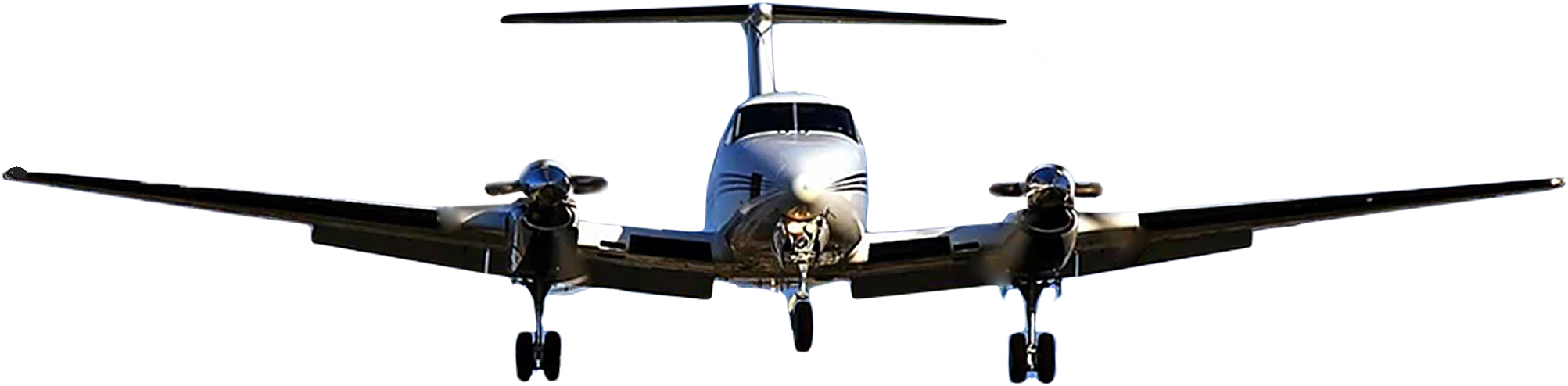


FAA type certificate data sheet A24CE, Revision 132, lists a minimum crew of two pilots for nineteen King Airs: Model 300 serials FF-1 through FF-19, which the FAA's BE-300 board report describes as modified for flight inspection. For the other King Airs on that sheet the entry starts with one pilot, which is why the King Air single pilot question usually gets a quick yes.
That yes covers one document out of four, and the four do not always agree.
Can you fly a King Air single pilot?
Under Part 91, usually yes. Every minimum crew line we found on a King Air data sheet says one pilot for Part 91 flying, except the FF serials. Four documents have to agree:
- The type certificate: minimum flight crew, on the data sheet and in the flight manual.
- The operating rule: 14 CFR 91.531 under Part 91, Part 135 for charter.
- The pilot's certificate: in a 300 or 350, a BE-300 type rating with or without a "Second in Command Required" limitation.
- The insurance policy, which can ask for a second pilot where the FAA does not.
A King Air that the FAA certificated for one pilot can still need two, because of a line on the pilot's certificate or a condition in the policy.
Minimum crew by model, from the FAA data sheets
We read each data sheet on November 27, 2026. Under 14 CFR 1.1, large means more than 12,500 lb maximum certificated takeoff weight and small means 12,500 lb or less. Weights and the type rating reasoning are in does a King Air require a type rating.
| Model | Data sheet | Weight class | Type rating | Minimum crew printed |
|---|---|---|---|---|
| King Air 90 series: 65-90, A90, B90, C90, C90A, C90GT, C90GTi, E90 | 3A20 Rev 82 | Small | No | None printed |
| King Air F90 | A31CE Rev 11, p.2 | Small | No | One pilot |
| King Air 100, A100, B100 | A14CE Rev 41 | Small | No | None printed |
| King Air 200, B200, B200GT | A24CE, pp.4, 11 | Small | No, unless modified above 12,500 lb | One pilot. B200 High Density Configuration under Part 135: one pilot and one copilot |
| King Air 300 | A24CE, p.31 | Large | Yes, BE-300 | One pilot. FF serials: two pilots |
| King Air 300LW | A24CE, p.31 | Small | No by weight, at 12,500 lb; the board report lists the 300LW under the BE-300 designation | One pilot |
| King Air 350 (B300, B300C) | A24CE, p.35 | Large, commuter category | Yes, BE-300 | One pilot |
The 90 and 100 series. 3A20 and A14CE list seat counts and print no minimum crew. Look in the Limitations section of your flight manual, which 14 CFR 91.9 makes binding. For the C90A, C90GT and C90GTi, the European data sheet EASA.IM.A.503 does print it: minimum flight crew, 1 pilot.
The 300 and 300LW. For the 300, A24CE (p.32) sends the reader to the flight manual's Limitations section "for Special Equipment Requirements for Minimum Crew of One Pilot," and the 300LW entry says the same in nearly identical words. Read that list before you plan a flight alone.
The FF serials. Note 10 on A24CE reads: "Two pilot requirements established by pedestal equipment location." The FAA's BE-300 Flight Standardization Board report, Revision 5, adds that FF airplanes modified under STC SA01267WI-D have a minimum crew of one pilot. The same report lists 350 and 360 among the marketing names. Neither appears on A24CE as a model, so find the model designation in your airplane's documents.
The data sheet does not always print a minimum crew, so the flight manual's Limitations section is the page to open first.
Published tuition. Travel expenses added if we come to you. Tuition shown takes effect January 1, 2027. Courses before then are at the current rate, so ask us.
Does a King Air 350 require two pilots under Part 91?
No, when its flight manual lists a minimum crew of one pilot. Paragraph (a) of the current 14 CFR 91.531 requires a pilot designated as second in command in three kinds of airplane:
- "Any airplane that is type certificated for more than one required pilot."
- "Any large airplane."
- "Any commuter category airplane."
A 350 falls under two of them: A24CE certificates the B300 in the commuter category, at 15,000 lb. Paragraph (b)(1) then takes it back out. A person may operate without a second in command "Any airplane certificated for operation with one pilot." The 300, a large airplane, gets the same exception. An unmodified FF serial does not, and its second in command must meet 14 CFR 61.55.
Under the current 14 CFR 91.531, a King Air certificated for one pilot may be flown by one pilot under Part 91, and the rule sets no seat count.
Older answers cite a limit of nine passenger seats for a single-pilot commuter category airplane. That was the text until Amendment 91-351, published June 27, 2018 and effective July 27, 2018, where the FAA wrote that paragraph (b)(1) "excepts any airplane that is certificated for operation with one pilot."
The 90, 100 and 200 never reach this section, as we read it. Under 14 CFR 91.501, subpart F covers large airplanes, turbojet-powered multiengine airplanes and fractional ownership program aircraft. At 12,500 lb or less, outside a fractional program, the crew number comes from the flight manual through 91.9.
What does Second in Command Required mean on a BE-300?
In most cases it means the pilot took the type rating practical test with a copilot. The 300 and 350 are large aircraft, so the pilot in command needs a type rating under 14 CFR 61.31(a), and the board report designates it BE-300.
14 CFR 61.43(b)(3) covers airplanes whose board report, flight manual or data sheet allows either a single pilot or a pilot and a copilot. The applicant may test either way, and "If the applicant performs the practical test with a copilot, the limitation of 'Second in Command Required' will be placed on the applicant's pilot certificate."
The airplane can be certificated for one pilot while the pilot's type rating is not.
The limitation may be removed when the pilot "passes the practical test by demonstrating single-pilot proficiency." Appendix 1 of the ATP and Type Rating ACS, FAA-S-ACS-11A, lists the tasks. That takes an examiner, and Access's published King Air 300 and 350 courses do not include a type rating practical test.
The rating brings no yearly FAA check. 14 CFR 61.58 covers aircraft type certificated for more than one required pilot, or turbojet-powered, and the board report says it "is not applicable for type-rated, single-pilot, turbopropeller airplanes." The two-pilot FF serials are the exception. The other clocks are in how often recurrent training is required.
King Air charter: when Part 135 asks for two pilots
On a charter certificate, 14 CFR 135.99 requires a second in command with ten or more passenger seats, and 135.101 requires one to carry passengers under IFR. 14 CFR 135.105 is the exception to 135.101: an operative approved autopilot, authorized in the certificate holder's operations specifications. Ask the certificate holder which applies to your airplane.
Can your insurance policy require a second pilot?
Yes. We found no insurer that publishes single-pilot terms for a King Air, so what follows comes from a broker and from an insurance executive at a brokerage.
BWI wrote on June 28, 2026 that King Airs can often be operated single pilot, that insurers evaluate single-pilot operations more conservatively and see two-pilot crews as lower risk, and that most prefer 1,000 or more total hours, higher for single-pilot operations.
Kyle White, an aviation insurance executive at a brokerage, writing in King Air Magazine in May 2018, recalled the 2003 market: on a B200 with $50 million of liability, many carriers would have required two pilots at all times, and single-pilot operations were limited to $25 million. In January 2025 he wrote that in the recent hard market brokers often needed several carriers to share a single-pilot risk above a $5 million hull value or $25 million of liability.
An underwriter can ask for two pilots in an airplane the FAA certificated for one, and that answer can change at renewal while the airplane stays the same.
A second pilot the policy asks for is a policy term. In a one-pilot airplane under Part 91, that pilot does not automatically become a second in command under 61.55, as our mentor pilot article explains.
Ask the broker in writing whether single-pilot flying is approved for each named pilot, at what liability limit, and what a required second pilot must hold. A hired pilot's training conditions sit in the same policy as the owner's: see training for professional pilots who fly an owner's aircraft and the King Air training page.
Frequently asked questions
Can you fly a King Air 350 single pilot?
Under Part 91, yes, when the flight manual lists a minimum crew of one pilot, the pilot's BE-300 type rating carries no Second in Command Required limitation and the insurance policy approves it. FAA data sheet A24CE lists one pilot for the B300 and B300C, and 14 CFR 91.531(b)(1) excepts any airplane certificated for operation with one pilot. The FAA's BE-300 board report lists the 360 as a marketing name under that data sheet and type rating.
Is a King Air C90 single pilot certified?
FAA data sheet 3A20 prints no minimum crew for the 90 series, so look in the Limitations section of your flight manual. The European data sheet EASA.IM.A.503 lists a minimum flight crew of 1 pilot for the C90A, C90GT and C90GTi. No type rating is required: 3A20 prints 10,100 lb for the C90A, C90GT and C90GTi, under the 12,500 lb line. Your insurer may still set its own conditions.
Does a King Air 200 require two pilots?
Not by the data sheet under Part 91: A24CE lists a minimum crew of one pilot for the 200, B200 and B200GT. The exception printed there is the B200 High Density Configuration in Part 135 operations, one pilot and one copilot. A charter certificate or an insurance policy can require a second pilot on its own terms.
My pilot's certificate says BE-300 Second in Command Required. Can that pilot fly my 350 alone?
Not as pilot in command, as we read the limitation. 14 CFR 61.43(b)(3) places it when the type rating practical test is flown with a copilot, and allows its removal when the pilot passes a practical test demonstrating single-pilot proficiency. The tasks are in Appendix 1 of FAA-S-ACS-11A.
What do underwriters want before they will write me single pilot in a King Air?
No insurer we found publishes it. Broker BWI wrote in June 2026 that most insurers prefer 1,000 or more total hours and more for single-pilot operations, require initial transition and annual recurrent training, and evaluate single-pilot flying more conservatively than a two-pilot crew. Ask your broker in writing what applies to each pilot on your policy.
Sources
- Type Certificate Data Sheet A24CE, Rev 132, King Air 200, 300 and 350, FAA, 2026.
- Type Certificate Data Sheet 3A20, Rev 82, King Air 90 series, FAA, 2019.
- Type Certificate Data Sheet A31CE, Rev 11, King Air F90, FAA, 2017.
- Type Certificate Data Sheet A14CE, Rev 41, King Air 100 series, FAA, 2017.
- Type Certificate Data Sheet EASA.IM.A.503, King Air 90, Issue 9, EASA, 2020.
- Flight Standardization Board Report, BE-300 (Models 300, 300LW, B300, B300C), Revision 5, FAA, 2021.
- 14 CFR 91.531, Second in command requirements, eCFR, 2026.
- 14 CFR 91.531, edition revised as of January 1, 2018, govinfo, 2018.
- Regulatory Relief: Aviation Training Devices; Pilot Certification, Training, and Pilot Schools; and Other Provisions, final rule, 83 FR 30232, FAA, 2018.
- 14 CFR 91.501, Applicability, eCFR, 2026.
- 14 CFR 91.9, Civil aircraft flight manual, marking, and placard requirements, eCFR, 2026.
- 14 CFR 1.1, General definitions, eCFR, 2026.
- 14 CFR 61.31, Type rating requirements, additional training, and authorization requirements, eCFR, 2026.
- 14 CFR 61.43, Practical tests: General procedures, eCFR, 2026.
- 14 CFR 61.55, Second-in-command qualifications, eCFR, 2026.
- 14 CFR 61.58, Pilot-in-command proficiency check, eCFR, 2026.
- 14 CFR 135.99, Composition of flight crew, eCFR, 2026.
- 14 CFR 135.101, Second in command required under IFR, eCFR, 2026.
- 14 CFR 135.105, Exception to second in command requirement: Approval for use of autopilot system, eCFR, 2026.
- Airline Transport Pilot and Type Rating for Airplane Category Airman Certification Standards, FAA-S-ACS-11A, FAA, 2023.
- King Air Aircraft Insurance in 2026: Cost, Pilot Requirements, and How Coverage Is Actually Structured, BWI, 2026.
- King Air Insurance Market Update, Kyle White, King Air Magazine, May 2018.
- Insurance column on the changing King Air insurance market, Kyle White, King Air Magazine, January 2025.
Access Flight Training ServicesRevised 2026-11-27